

• Skip to main content
  • Skip to after header navigation
  • Skip to site footer

The Steve Laube Agency

Helping to Change the World…Word by Word

The Steve Laube Agency

The Steve Laube Agency

Helping to Change the World Word by Word

  • Home
  • About
    • Who We Are
    • Frequently Asked Questions
    • Interview with Steve Laube
    • Statement of Faith
    • Terms and Conditions
    • Privacy Policy
  • Guidelines
  • Authors
    • Who We Represent
    • Awards and Recognition
  • Resources
    • Recommended Reading
    • Christian Writers Market Guide Online
    • Christian Writers Institute
    • Writers Conferences
    • Freelance Editorial Services
    • Copyright Resources
    • Research Tools
    • Selling What You Write
  • Blog
  • Contact
  • Twitter
  • FaceBook
  • RSS Feed
  • Get Published
  • Book Proposals
  • Book Business
  • Writing Craft
    • Conferences
    • Copyright
    • Craft
    • Creativity
    • Grammar
  • Fun Fridays
Home » Archives for Steve Laube » Page 133

Steve Laube

A Defense of Traditional Publishing: Part Three

By Steve Laubeon April 26, 2011
Share
Tweet
20

EDITORIAL

I need to clarify what I’m attempting to do with this series of posts. I am not digging deeper trenches and pouring the dirt over a head that is already buried in the sand. Some think I’m defending a dying industry and failing to see the changes around it. This series is merely an attempt to remind us what traditional publishers do well. Their critics are jettisoning all of traditional publishing as antiquated. But I posit that there is good to be found in the things that brought publishing to this place.

Today’s topic is Editorial – or more completely, “Content Development.”

Many critics say that the day of great editors is past. The legends are gone and instead we now have overworked editors who don’t have time to spend crafting and developing an author’s content into a masterpiece. They have become paper-pushers.

While editors are generally overworked…that is not anything new. It has been that way for a long time. While at Bethany House Publishers I managed the acquisition and editorial development of nearly fifty titles per year. But I did not work alone.

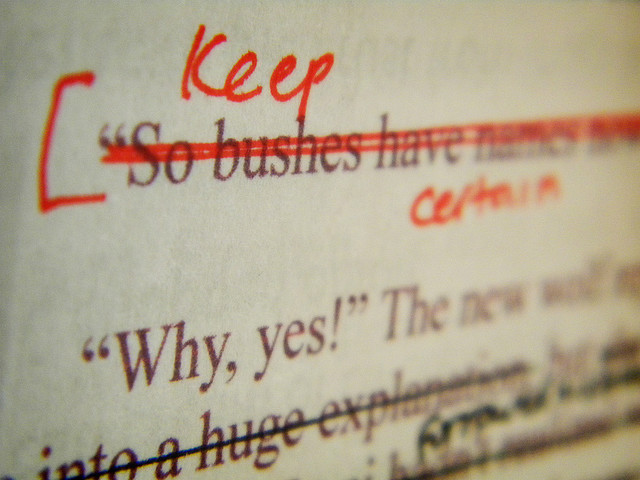
Editing is a multi-person process in the traditional publishing companies. First is the acquisitions editor who finds, defends, acquires, and negotiates the acquisition of a project (i.e. The Curator). Many times the actual content edit (also call the “line”  or “substantive” edit) is done by a different person. The content editor looks for accuracy, balance and fairness, cogency of argument, adequate treatment of the defined subject matters and issues, and also includes conformity to all aspects of the description of the work contained in the original book proposal. (That sentence is an adaptation from actual contract language defining an “Acceptable” manuscript.)

Next comes the copy editor who scours the manuscript looking for accuracy in grammar, citations, and factual content. Then it is sent to a proof reader who scours the work for fine-tuned details in punctuation and other tiny details.

These editors are amazing people. And despite the cutbacks in many major publishing houses there are still a number of truly incredible men and women who stay behind the scenes and pour their minds and hearts into the books they work on.

In the Christian industry I’ll highlight one man as an example (and he will likely be embarrassed by this!). David Kopp is an exceptional editor with Waterbrook Multnomah. He was the one who created the eight million copy bestseller The Prayer of Jabez out of a nearly unpublishable massive manuscript. He worked on the bestseller Do Hard Things by the Harris brothers. And recently he helped transform a book about missions into what is now called Radical (by David Platt) that has been on the NY Times bestseller list for 43 weeks (as of this writing).

This is the type of talented person that sits unknown in an office in a traditional publishing house… helping to create magic. I could rattle off a dozen or more names off the top of my head of similar people who make this happen every day. And that does not include the number of freelancers who are hired by publishers to take up the slack when they cannot meet the demands of the editing process in-house.

A critic might say, “But I can just hire these freelance people myself. Why do I need a traditional publisher?” That is a good point. But it misses a critical part of the process. It is illustrated by the question, “Who pays the invoice?”

Think about it for a moment. In a traditional publishing house the publisher is basically in charge. If there is a major dispute over editorial changes or input, the publisher has final say and contractual clout. Rarely is this used as a hammer, but the writer always knows it is there. In almost every case there are long discussions and a compromise is achieved.

But when the author hires the editor, who is the boss? The writer is the boss. The writer will usually defer to an editor’s comments. But what if your novel is going down a terrible path, a path to commercial destruction? I know of a case where an author was bent on writing a particular storyline and would not take anyone’s advice. His agent was unsuccessful. His writing friends and critique partners could not sway him from the path. If he were self-publishing he would have failed miserably. Instead an editor at a traditional publishing house recognized the talent and came alongside with valuable suggestions. The author, realizing that the editor had the goal of creating a great book, acceded to the advice. The book was saved, is now in print, and being sold in stores everywhere.

I also know of another case where a freelance editor took an author’s manuscript (to be self-published) and rearranged the non-fiction content from a topical presentation to a chronological presentation. (The book was the history of a specialized type of job in our court system.) The editor felt that a history should be told chronologically instead of topically. The author disagreed and made the editor put it all back the way it was in the first draft. Because the author was “paying the invoice” the author’s wishes prevailed. The book did not sell and was not adopted as a textbook, which was the goal of the author.

James Michener once said, “I’m not a good writer; I’ve been a masterful re-writer.” He has a fascinating book called James A. Michener’s Writer’s Handbook (1992). In this work are reproductions of the interaction between Michener and his editor. You can see the original text, the editorial suggestions, and the rewrite. A interesting exchange that is rarely seen.

As with the idea of “curation” I believe the editorial or content development process is a vital part of what a traditional publisher does for an author’s work.

Part One: Introduction

Part Two: Curation

Part Three: Editorial

Part Four: Design

Part Five: Infrastructure


Leave a Comment
Category: Book Business, Defense of Traditional Publishing, The Publishing LifeTag: Content Development, publishing, Traditional Publishing

A Defense of Traditional Publishing: Part Two

By Steve Laubeon April 20, 2011
Share
Tweet
25

CURATION

The word "curation" embodies one of the key activities of a traditional publisher. My understanding of this word has been forever enriched by Steven Rosenbaum, the author of the fantastic book Curation Nation: Why the Future of Content is Context. (You owe it to yourself to read this book.)

We usually associate the curator with a museum.

Read moreA Defense of Traditional Publishing: Part Two
Category: Book Business, Book Review, Defense of Traditional Publishing, Get Published, The Publishing LifeTag: Agents, Book Business, Digital Books, E-Books, Get Published, Traditional Publishing, Trends

A Defense of Traditional Publishing: Part One

By Steve Laubeon April 12, 2011
Share
Tweet
17


INTRODUCTION

There has been a plethora of new developments in the publishing industry causing the blogosphere, writers groups, and print media to light up with opinions, reflections, and advice. Some of it has been quite brilliant, other parts, not so much.

I would like to attempt to address the positive elements of traditional (or legacy) publishing as a defense of the latest …

Read moreA Defense of Traditional Publishing: Part One
Category: Book Business, Career, Defense of Traditional Publishing, The Publishing LifeTag: Book Business, Digital Books, E-Books, Get Published, rumors, Traditional Publishing, Writing Craft

Book Trailers: Vital or Wasteful?

By Steve Laubeon February 17, 2011
Share
Tweet
20

Book trailers, if done well, can be a cool component to the marketing of your project. If done poorly or if done cheaply they do very little to impress a potential reader.

Most authors love to see their work done this way. In some ways if feels like the story has made it to the "big screen."

But does it sell books? When was the last time you clicked and then bought because of the trailer?

Read moreBook Trailers: Vital or Wasteful?
Category: Branding, Marketing, Platform, TrendsTag: book trailer, Trends

Count Your Many Phrases

By Steve Laubeon February 10, 2011
Share
Tweet
28

We all have our pet phrases and they can inadvertently sneak their way into our manuscripts. Yesterday I came across a marvelous web site that can help you discover how often your repeat a particular phrase in your article or manuscript.

Using the Phrase Frequency Counter online, you can actually track what phrases you overuse. It is also a great way to pick out those clichés that can creep …

Read moreCount Your Many Phrases
Category: Editing, Grammar, Writing CraftTag: Creativity, Writing Craft

New and Improved

By Steve Laubeon February 8, 2011
Share
Tweet
9

After more than a month of work we are excited to announce the launch of our new and improved web site!

Please take a look around and tell us what you think...and if you find any bothersome glitches. Feel free to leave your comments.

Kuddos to Thomas Umstattd and his team at Authormedia.com for their work. They bent over backwards and put up with my obsession over the most minute of details …

Read moreNew and Improved
Category: AgencyTag: Personal

What was on Your Bestseller List?

By Steve Laubeon January 11, 2011
Share
Tweet
6

What was the bestselling novel or non-fiction book the week you were born? Follow this link to a delightful search engine on Biblioz, an Australian company. Make sure you type the date first (not the month).

It is a bit startling to see how fleeting the popularity of books can be. They were the most popular in the country at the time! But I have to admit that I don't recognize most of the …

Read moreWhat was on Your Bestseller List?
Category: Publishing A-Z, TrendsTag: Book Business, Bookselling, Personal, Trends

Book Tour Lesson: Listen to Publisher

By Steve Laubeon January 10, 2011
Share
Tweet
5

Melanie Benjamin, author of Alice I Have Been, reflects on book tours, in an article for the Huffington Post.  Especially the difference between the one she put together herself several years ago and the one she is currently doing with the help of her publisher.
"I've also learned to listen to my publisher. When a bookstore contacts me personally about an appearance, I pass the request on to my …

Read moreBook Tour Lesson: Listen to Publisher
Category: Book Business, Career, MarketingTag: book tours, Marketing, publisher

Someone Hacked My Website

By Steve Laubeon December 22, 2010
Share
Tweet
7

And a "Merry Christmas" to me... (sarcasm dripping).

In the last 24 hours someone hacked my web site by utilizing a security hole in my host server. They didn't need even my password! They were able to piggyback on these blog posts and added 853 scripts to my web site redirecting visitors to malicious sites. These little beasts are also known as Malware.

Read moreSomeone Hacked My Website
Category: AgencyTag: Agency, Hacked, Website

Lawsuit over Hyperlink?

By Steve Laubeon December 20, 2010
Share
Tweet
6

In Canada a man is suing another person for linking to allegedly damaging web content on a web site (the suit is currently before the Canadian Supreme Court).  A big "thank you" to Mac Slolcum for writing about this issue last week. In his article Mac asks the pertinent question, "Is a link on your web site equivalent to an endorsement of that content?" Think about it for a second. If you click …

Read moreLawsuit over Hyperlink?
Category: Book Business, Legal IssuesTag: Endorsements, Facebook, Internet Usage, Marketing
  • Previous
  • Page 1
  • Interim pages omitted …
  • Page 131
  • Page 132
  • Page 133
  • Page 134
  • Page 135
  • Page 136
  • Next

Sidebar

Get Blog Updates

Enter your email address to get new blog updates delivered via email. You can unsubscribe at any time.

You have Successfully Subscribed!

Grow as a Writer


Find Out More →

Popular Posts

Top Posts on Book Proposals
  • Hints for a Great Cover Letter
  • The Keys to a Great Book Proposal
  • What Steve Laube is Looking For
  • Book Proposals I’d Love to See – Tamela Hancock Murray
  • What I’m Looking for – Bob Hostetler
  • What I’m Looking for – Dan Balow
  • What I’m Looking for – Lynette Eason
  • What’s the Best Way to Submit My Self-Published Book?
  • What Is the Agent Doing While I Wait?
  • God Gave Me This Blog Post
Top Posts on The Business Side
  • When Your Book Becomes Personal
  • The Myth of the Unearned Advance
  • How Long Does it Take to Get Published?
  • What Are Average Book Sales?
  • Can You Plagiarize Yourself?
  • Never Burn a Bridge
  • Who Decides to Publish Your Book?
  • That Conference Appointment
  • Goodbye to Traditional Publishing?
  • Who Owns Whom in Publishing?
  • Ten Commandments for Working with Your Agent
  • Writers Beware! Protect Yourself
Top Series
  • Book Proposal Basics
  • Publishing A-Z
  • A Defense of Traditional Publishing
Top Posts on Rejection
  • The Slush Pile: Enter at Your Own Risk
  • Even the Best Get Rejected
  • Five Reasons Why You May Never Get Published
  • The Unhelpful Rejection Letter
  • Writers Learn to Wait

Blog Post Archives by Month

  • Home
  • About
    • Who We Are
    • Frequently Asked Questions
    • Interview with Steve Laube
    • Statement of Faith
    • Terms and Conditions
    • Privacy Policy
  • Guidelines
  • Authors
    • Who We Represent
    • Awards and Recognition
  • Resources
    • Recommended Reading
    • Christian Writers Market Guide Online
    • Christian Writers Institute
    • Writers Conferences
    • Freelance Editorial Services
    • Copyright Resources
    • Research Tools
    • Selling What You Write
  • Blog
  • Contact

Copyright © 2026 · The Steve Laube Agency · All Rights Reserved · Website by Stormhill Media